

Change in Practice: Protecting the Change during Implementation
Why Leaders Must Guard Focusing During Implementations

When Everything Feels Like a Decision
In Part 4: Change in Practice: Decision clarity organizational change, we explored why every implementation needs a guiding force: a shared understanding of why the organization is changing and what should be different when the work is done.
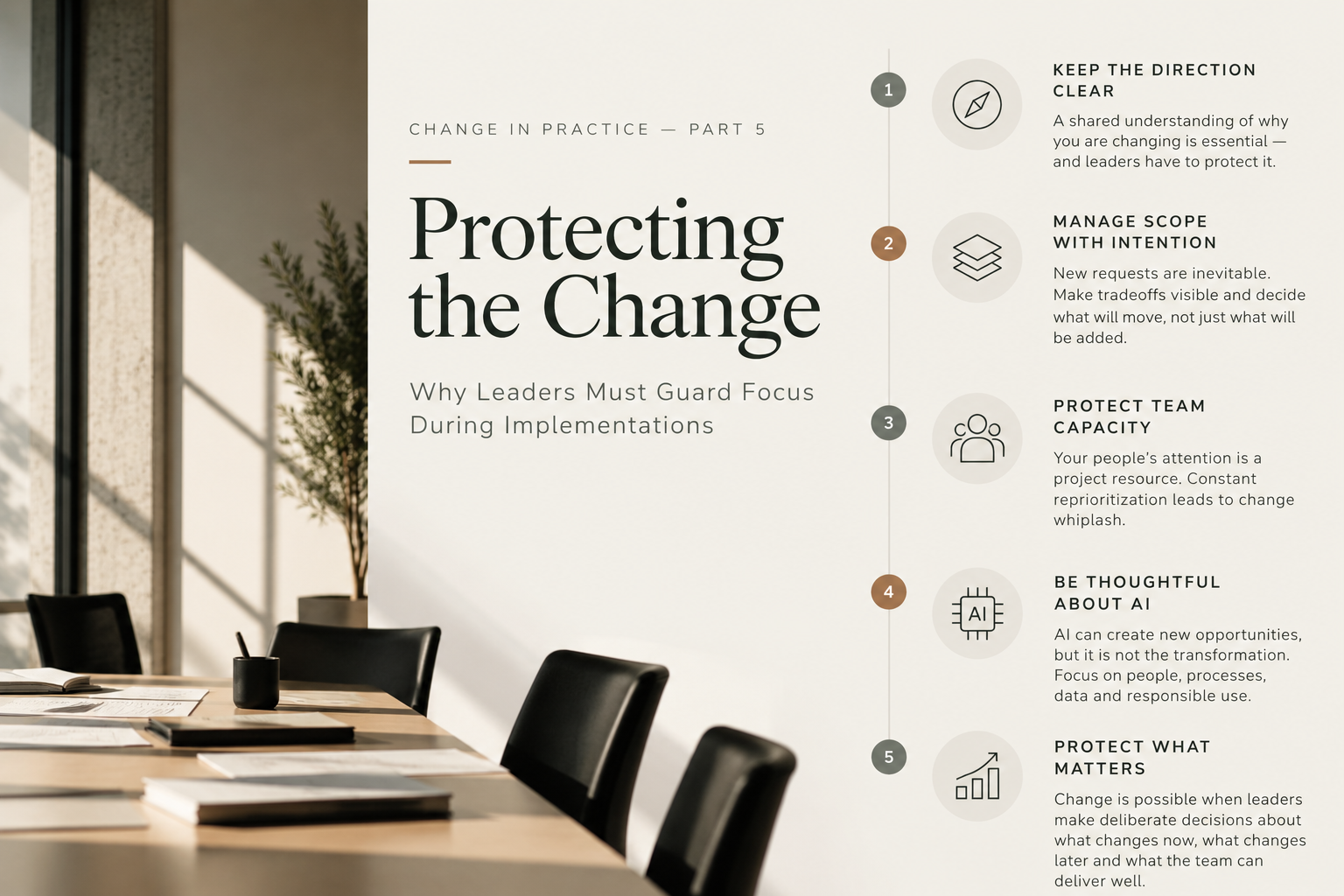
But defining that direction is only the beginning. Leaders have to protect it.
As an implementation progresses, new requests appear. Another initiative becomes urgent. Someone asks whether a feature can be added while the team is already changing the system. Each request may sound reasonable on its own. Together, they can pull people away from the work the organization originally asked them to deliver.
That is how teams experience change whiplash. They are expected to commit to a direction while the direction keeps moving.
The Cost of Constant Reprioritization
Implementation teams are often praised for being adaptable. They should be. New information can reveal a risk, an overlooked worker population, or a process that will fail in practice. A responsible team needs room to respond.
But adaptability has a cost when every new idea becomes an immediate priority. During a payroll or HR technology implementation, constant reprioritization can directly affect testing, readiness and go-live preparation.
Consider a payroll team preparing for parallel testing. It needs time to investigate differences, confirm time data, validate calculations, and resolve issues before the next test cycle. If the same people are repeatedly pulled into new design requests or unrelated initiatives, the testing dates may stay on the calendar, but the time needed to do the work disappears.
The team then faces a familiar choice: work longer, test less deeply, or push unresolved issues closer to go live. None of those choices should happen quietly.
Constant reprioritization also changes how people respond to decisions. When priorities are frequently reversed, teams hesitate to commit. They keep alternate processes alive and wait to see whether the latest direction will last. The organization may see a project that is still moving. The people doing the work feel the uncertainty beneath it.
How Leaders Can Protect Focus During Implementation
Leaders do not usually set out to disrupt an implementation. They may be trying to respond to a business need, remove an obstacle, or make the most of an investment. But leadership attention carries weight. A question from an executive can become urgent work before anyone has decided whether it belongs in the current phase.
“Could we also add this?” may require new design, configuration, integration changes, security review, testing, communications, and training. The request is bigger than the moment in which it was made.
Another common pattern is adding priorities without removing any. The team is told that the original deadline still matters and the new request matters too. People are left to absorb the conflict themselves.
Leaders protect progress by making those tradeoffs visible. If a new requirement is essential, what work will move? Who will assess its downstream impact? What will it mean for testing and readiness? Who has the authority to decide?
Those questions prevent a casual request from becoming an unexamined commitment.
AI During Implementation: Another Reason to Protect Focus
This is especially relevant as organizations explore AI during other major changes. A team implementing a new HR or payroll system may also be asked to evaluate AI features, automate more decisions, or redesign roles around new capabilities.
Some of that work may be valuable. But as I have said in my presentation, AI is not the transformation. The transformation is in how people understand the work, make decisions, build trust in the information, and use new capabilities responsibly.
An AI opportunity does not erase unresolved process questions or create more capacity for the people already carrying the implementation. Before adding it to the plan, leaders need to ask whether the organization has clear ownership, reliable data, a defined use case, and time to test what happens when the technology is wrong or uncertain.
Sometimes the best decision is to pursue the idea in the current phase. Sometimes protecting the larger transformation means giving that idea its own deliberate place later. Both can be signs of strong leadership.
Boundaries Make Change Possible
Protecting change does not mean refusing every new request or treating the project plan as untouchable. It means giving the team a dependable way to assess what has changed.
A useful boundary is to ask three questions whenever a significant request appears:
· Does this support the outcome we agreed to deliver?
· What will it take to implement and test well?
· What will we move or stop so the team has the capacity to do it?
The answers may lead to a scope change, a later phase, or a decision that the request is more important than something already planned. What matters is that the choice is explicit.
Leaders also need to protect the team’s energy. An implementation depends on people who know the details: the payroll specialist who understands an exception, the manager who knows how time is approved, the analyst who can explain why the data does not reconcile. Their attention is a project resource. Filling every open hour with meetings and competing requests leaves less room for the careful work that makes go live possible.
Protect What You Said Matters
A guiding force helps an organization choose its direction. Leadership makes that direction credible by protecting the time, capacity, and decisions needed to reach it.
When new information warrants a change, change the plan openly. When a request can wait, say so. When the deadline and the work no longer fit together, acknowledge the tradeoff before the team is forced to make it alone.
Change fails when it is not protected. And protection is rarely one dramatic decision. More often, it is the steady leadership practice of remembering what matters and making room for people to deliver it.
Transition to Part 6
Even when leaders protect the work during an implementation, there is another challenge waiting after the team moves on: Will the organization remember why decisions were made and how the new process is meant to work? In Part 6, we will explore organizational memory and what happens when knowledge lives only with the people who carried the change.